If you’ve discovered damaged wood in your home, one of the first questions is: is it carpenter ants or termites?
For homeowners in New Jersey, this distinction is critical. While both pests are associated with wood damage, the type of damage, risk level, and treatment approach are completely different. Misidentifying the problem can lead to ineffective treatment and costly repairs.
Understanding the difference between carpenter ant damage and termite damage helps you take the right action quickly and protect your home from further damage.
Why It’s Important to Tell the Difference
Carpenter ants and termites are often confused because both are found near wood structures. However, their behavior is very different.
Carpenter ants excavate wood to create nesting galleries, while termites consume wood as a food source. Because of this, termite damage tends to spread more aggressively and can go unnoticed for longer periods.
Accurate identification allows homeowners to apply the correct treatment, eliminate the source of the infestation, and avoid long-term structural issues.
What Carpenter Ant Damage Looks Like
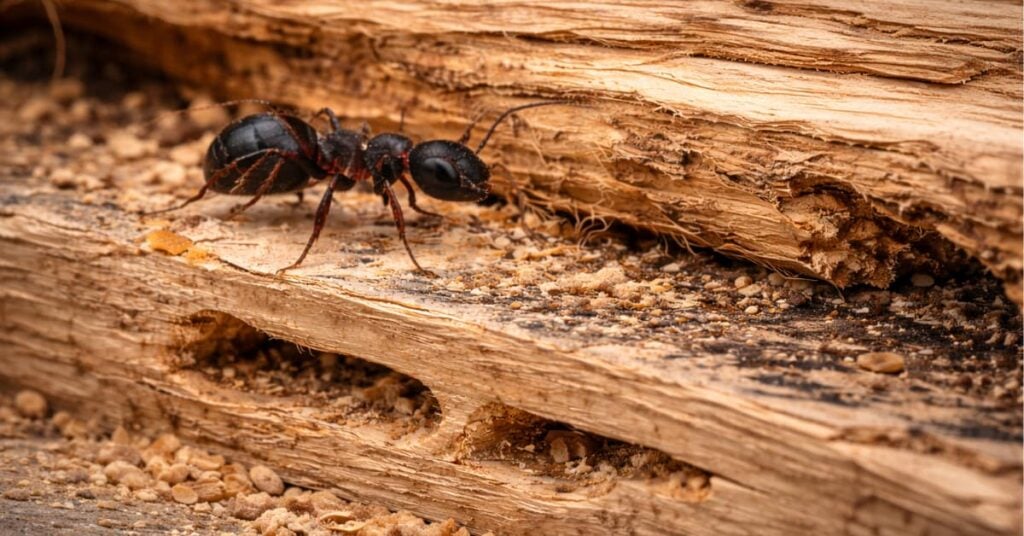
Carpenter ants create smooth, hollowed-out tunnels inside wood. These galleries are clean and polished in appearance because the ants remove debris as they expand their nesting areas.
Key Signs of Carpenter Ant Damage:
- Smooth, sanded-looking tunnels inside wood
- Small piles of wood shavings (frass) near openings
- Faint rustling sounds inside the walls
- Large black ants are visible indoors, especially at night
Carpenter ants are typically drawn to moisture-damaged or weakened wood. You’ll often find them in areas like basements, window frames, rooflines, or near plumbing leaks. Their presence may indicate an underlying moisture issue that should also be addressed.
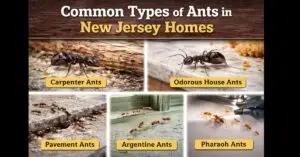
Learn how to identify species here: Common Types of Ants in New Jersey Homes.
What Termite Damage Looks Like
Termite damage is very different and often more serious. Termites eat wood from the inside out, which means visible signs may not appear until the damage has progressed.
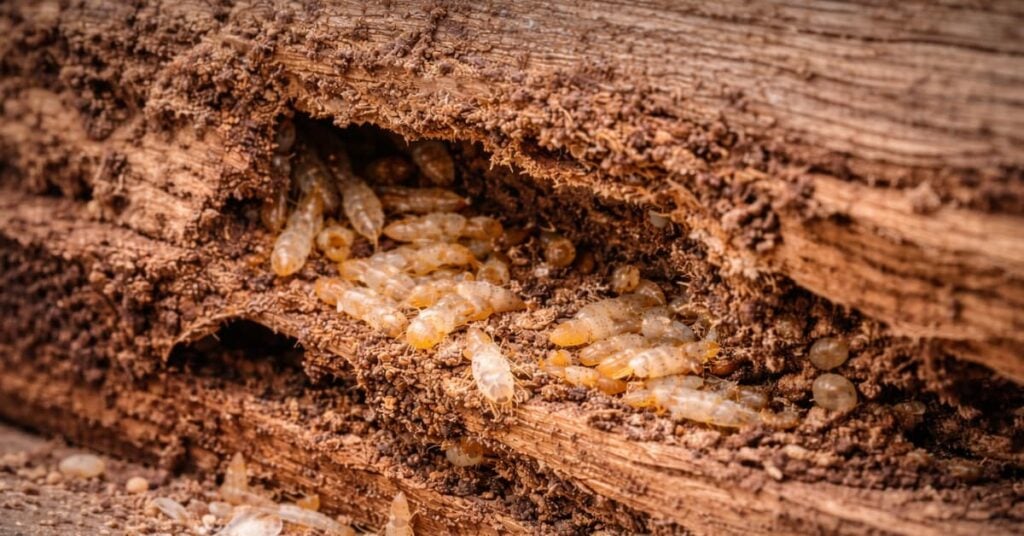
Key Signs of Termite Damage:
- Hollow-sounding wood when tapped
- Mud tubes along foundation walls
- Blistering or bubbling paint surfaces
- Discarded wings near windows or entry points
Unlike carpenter ants, termites avoid light and remain hidden within walls, soil, or structural wood. This makes early detection more difficult and increases the risk of widespread damage.
See early warning signs: Early Signs of Termite Damage in Your Home.
Carpenter Ants vs Termites: What’s the Difference?
Carpenter ants and termites differ in several important ways that impact how infestations are treated.
Carpenter ants do not eat wood but instead carve smooth tunnels through it, leaving behind visible wood debris. They are larger in size and more likely to be seen moving through a home, especially at night. These ants are strongly attracted to moisture-damaged areas.
Termites, on the other hand, consume wood continuously and create rough, mud-lined tunnels. They rarely appear in open areas because they avoid light, and they do not leave behind wood shavings. Their colonies can remain hidden for long periods, causing damage without obvious warning signs.
Where NJ Homeowners Commonly See Damage
In New Jersey homes, both carpenter ants and termites tend to appear in areas where conditions are favorable.
Carpenter ants are most commonly found in damp basements, window frames, decks, and areas where moisture is present. They are often associated with water damage or high humidity levels.
Termites are typically found along foundation walls, crawl spaces, wooden support beams, and areas where wood comes into direct contact with soil. Because they originate underground, they often enter through the lowest points of a structure.For more localized pest insights, homeowners can reference Rutgers Cooperative Extension pest resources, which provide region-specific guidance for New Jersey.
Which Pest Is More Dangerous?
Both carpenter ants and termites should be taken seriously, but termites generally pose a greater long-term structural risk.
Termites can silently damage load-bearing components of a home, often without detection until significant repairs are needed. Carpenter ants tend to spread more slowly, but over time, they can still weaken wood structures—especially if moisture issues are not corrected.
The key is early detection and proper treatment before the problem escalates.
What Causes These Infestations?
Both pests are attracted to specific environmental conditions that are common in many New Jersey homes.
Moisture is one of the leading factors, whether from leaks, poor drainage, or humidity buildup. Wood-to-ground contact, foundation cracks, and nearby landscaping can also provide easy access into the home.
Homes with untreated wood, poor ventilation, or drainage issues are more likely to experience recurring infestations.
When to Call a Professional in New Jersey
If you are unsure whether you are dealing with carpenter ants or termites, a professional inspection is the safest and most effective step.
You should consider expert service if:
- You notice ongoing or worsening wood damage
- Ants or termites continue to return after treatment
- You find mud tubes, frass, or hollow wood
- You hear activity inside walls or ceilings
- DIY methods have not resolved the issue
Professional identification ensures the correct treatment is applied the first time, preventing further carpenter ant damage, termite damage and repeated infestations.
How to Help Prevent Future Damage
Reducing the conditions that attract these pests is key to long-term protection.
Prevention Tips:
- Fix leaks and eliminate excess moisture
- Seal cracks around foundations, doors, and windows
- Keep firewood and debris away from the home
- Maintain proper drainage around the property
- Schedule routine pest inspections
These steps help create an environment that is far less attractive to both carpenter ants and termites.
Local Pest Control You Can Trust in New Jersey
If you’re dealing with wood damage and aren’t sure what’s causing it, proper identification is essential.
At Terminator Termite and Pest Management, we provide expert inspection and treatment services across Mercer County, Monmouth County, Ocean County, Somerset County, and Middlesex County, New Jersey. Our team identifies the source of the problem and delivers targeted solutions designed for long-term protection.
Get expert help here: Termite Control & Carpenter Ant Control Services in New Jersey, or contact us today.
FAQs About Carpenter Ant Damage vs Termite Damage
Can carpenter ants turn into termites?
No, they are completely different species and require different treatment methods.
Do carpenter ants mean there is moisture damage?
In many cases, yes. Carpenter ants are commonly attracted to damp or decaying wood.
How quickly can termites damage a home?
Termites can cause significant damage over time, especially if the infestation goes undetected.
Is termite damage covered by insurance?
Most standard policies do not cover termite damage, as it is considered preventable.
Can I treat carpenter ants and termites the same way?
No, each pest requires a specific treatment approach for effective control.